

Concert Review: Ryan Adams @ The Uptown Theater (Napa, Ca)

( @theRyanAdams, #Napa, @JasonIsbell )
Opening Act: Jason Isbell
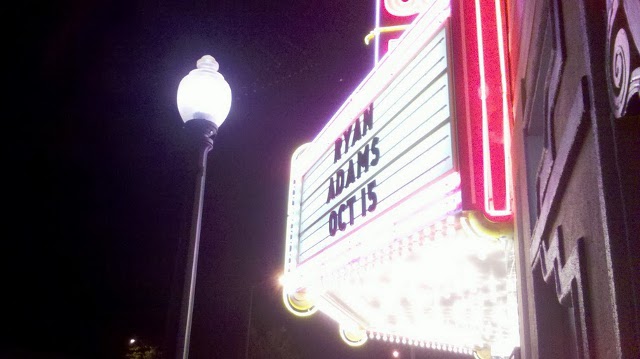
Date: Saturday, October 15th, 2011
Location: Uptown Theater – Napa, Ca

When Ryan Adams announced he was taking a break a few years ago I really wondered if he was going to play live again. Articles about Meniere’s disease and burn out made it seem like it could be a long time before a tour would be a reality. In the spring, Ryan announced select dates in Europe and I started putting away some money for a trip to California (Europe was too expensive, and I figured he might do a few dates near his home), he surprised many with a full blown tour. Long story short: I get to see him twice this year, as you can see in this review, I have no complaints.
[Opening Act: Jason Isbell]

Normally, I do a little research on opening acts, but I have been so busy with work that I completely forgot to do it. When Jason Isbell walked on stage and announced he was Muscle Shoals, Alabama I whispered to my wife “I wonder if he is in The Drive By Truckers” thanks to an piece I heard about them on NPR. He quickly confirmed my suspicions.

Isbell was sublime. I am so glad that I didn’t know much about him or his material because I had a chance to absorb his performance without any expectations. He is an outstanding guitar player and singer. Isbell has a natural way of bantering with the audience that comes from experience. Jason did a song that was based on a conversation with his dad that really sent a shiver up my spine. I can’t wait to get home and track down this guy’s back catalog because he is such a good songwriter.

[The Main Event: Ryan Adams]

Ryan Adams was excellent in every way last night. Since the venue held under 1,000 people and the show was billed as an acoustic performance, it was a very intimate. The one thing that stood out to me (after having gone to several Ryan Adams concerts) – is just how good his voice sounded. Ryan’s ability to convey emotion through his voice is often overlooked in favor of his prolific songwriting, but his voice might be the greatest weapon in his arsenal.

This was most definitely a thank you show to the fans. He played the perfect mix of “greatest hits”, new tunes, and fan favorites. Since he was solo, he tweaked several songs to make up for the lack of a band. The subtle changes were welcome and kept me listening for the changes. Ryan did a really nice solo at the end of “I see Monsters” that was new but fit perfectly. I am not going to rattle off every tune Adams played, but I am happy to have witnessed live performances of “Winding Wheel” and his piano version of “New York, New York” (they were awesome).

Ryan bantered with the crowd throughout the show. There was no tension. A few people in the crowd shouted out requests, but Ryan took it in stride and moved on with his set list. He broke out several improvised songs about people moving around going to the bathroom (it was funny, he kept asking them to come back, “Its not 2004!”). And the end of the main set, Adams soaked in the applause of the crowd. I have been to several Ryan Adams concerts in the past where he ran off the stage at the end of the show, it was nice to say thank you properly this time.

Ryan came back out and did a few tunes with Jason Isbell. He ended the show with an old Whiskeytown song “Jacksonville Skyline” – it was a fitting and satisfying ending to a memorable performance.. This show was a mutual love note between Ryan and the crowd and I am really glad I had a chance to witness it.

[The Curse]

I can’t do a concert review without sharing crowd experiences. I thought I was going to break the curse last night and not have any issues with an audience member because this was a fan oriented show. Wrong. There were four girls in front of us that talked THE ENTIRE TIME. At first the main offender was trying to keep it low, so it was easy to ignore her, but as the night progressed they all got sloppy drunk. She had to sing every song. She was told several times to quiet down, but as they got drunker she just laughed. Did I want to push her down the steps at the end of the night? I can’t say (yes). Oh well – at least she knew the words…

UPDATE:
Ryan posted this clip from the show on his facebook page
Customer Service: Pep Boys

( @pepboysauto, #repairs )

I had an interesting couple of days with our cars. On Thursday, my friend known as GTT texted me to tell me that my wife’s car in the driveway had a flat tire. I was in the office and could not deal with it until I got home (my wife and I carpool). Long story short, there was a screw in the tire and I decided to wait until the next day since we were both working from home.

The next morning, we got the spare on and I followed Allison over to Pep Boys so she could get the tired repaired. Heading down Woodbury-Glassboro Road in Pitman, the cops decided to have a check-point. Allison got through with no issue, but my car had a brake light out, and when they pulled me over I informed them that my driver-side window was broken. This thing has been giving me trouble for months (it kept getting stuck). Long story short, I got stuck with the cops for a while, but didn’t get a ticket. I knew I had to get this thing properly fixed. So after her car was fixed, we left mine. I knew this was not going to be cheap.

This is where I will pause and pose a question that I generally get: “Why do you take your car to Pep Boys?”

My answers are many and there will be several in the course of this little story:
1. They are close
2. They are a corporation, so should I get poor service (which I have not), there is a chain of command I can follow to get my issues resolved.
3. They always have parts
4. They are much much better than Firestone (I have a whole story with them for another day).

One other thing about this particular chain (Glassboro, NJ), they have done several small fixes for my wife and I at no cost. A month ago, a heat shield half fell off my car and they removed it and cleaned up the area at no cost (and told me I didn’t need anything else to be done even though I was willing to get repairs done). They also fixed my wife’s flat at no charge (but I think that comes with their tire service when you buy from them – but either way, it was nice).

Back to my story, the manager called me and told me the repair was not going to be cheap (over $500) because the motor in the window had to be replaced. As I said, I was expecting this. They had to get a part from another store, but the car would be done that day. THAT DAY. When the car was done and I went in to pay, they let me use a 10% off coupon and the cashier noticed I had a $30 mail in credit that I didn’t think I could use in combination (so I didn’t mention it), but they saw it in my hand and let me use. Pep Boys sends coupons for service almost every month. Its smart of their part but also works out well for the consumer.

I figured I would put this out there since several popular blog posts document my negative experiences with car rental places, ticketmaster, and other retail outlets. I always have decent experiences with Pep Boys and never feel like I got taken advantage of. Their monthly coupons are smart because they keep us thinking about services for our cars. They execute a nice mix of good service, good marketing, and availability. Well done.

Book Review: Water for Elephants

( #WaterForElephants, #SaraGruen )

I finished reading “Water for Elephants” by Sara Gruen a few nights ago and decided to share my thoughts.

Who doesn’t love the circus? Animals, peanuts, drunk little people. Writer Sara Gruen picked this fertile backdrop to tell a love story and it was a good choice because I hate reading love stories. Getting right to the point, the most interesting aspect of this book is the actual circus history that Gruen cherry-picked for the story. The background characters, the economics of the circus, and the stories about the animals sell this book.

The dynamic of the “love triangle” and the main character’s circumstances are overly convenient and contrived. Within a few pages, the main character Jacob loses his family, his family’s business, drops out of school, and magically finds a circus to work at. I can forgive that because Gruen gets right to the meat. The “love triangle” setup was harder to swallow. Like any other book that has a likable lead that hooks up with a married woman, the husband has to be a complete sociopath. The husband beats the wife, the animals, and throws sick employees off the train. The hero Jacob sweeps in to save the beaten Marlena, ensure the crazy husband gets what he deserves, and of course saves the animals. All is wrapped up with a pretty little bow (forgetting the characters that paid the price for Jacob to have his affair).

Gripes aside (because honestly I would have issues with any romance novel), I liked the book because it was well researched and told interesting side stories. Now I am going to go rummage through my DVD collection and start watching Carnivale again.

Oh yeah they made a movie out of the book too (I have not seen it).

Book Review: Robopocalypse

( #Robopocalypse, @danielwilsonpdx)

I recently finished reading the book Robopocalypse by Daniel H. Wilson and here are my thoughts about it.

If you can’t figure it out by the title, Robopocalypse is a fictional story about machines and robots gaining a collective sentience and turning against humans. Slightly less horrific than the opening scenes in the Terminator movies, Wilson still manages to paint a gruesome picture. Society becomes dependant on robot assistance and is woefully unprepared for the slaughter even with several warning signs.

Wilson borrows the format from another apocalyptic novel: World War Z by Max Brooks. If you are going to rip off a horror book, might as well rip off one of the best. Like WWZ, the narrative in Robopocalypse is relayed by a “main character” but told in sections through a series of other characters. The main character is a soldier rather than a writer that comes across a device that collected the stories/horrors from whatever camera/robot that happened to be within the area of said tale.

The book is really entertaining, but due to the strong similarity to World War Z, it is hard not to compare the two books. In comparison, Robopocalypse is not as well thought out. One of the more appealing aspects of WWZ was how humanity rebuilds as a result of the disaster. Wilson gives tiny hints of society post Robopocalypse but nothing satisfying. While the “villain” in the book is defeated, you don’t learn about how the main characters reconnect and move on with their lives, which is a let down. As an example, Wilson introduces humans modified by the robots that managed to get free. They are horribly maimed and implanted with electronics. I really wanted to know more about these character’s outcomes (and felt they should have been more prevalent during the final showdown). That being said, Wilson left enough meat on the table for a sequel, so all sins might/could/probably will be forgiven.

Complaints aside, Robopocalypse was a well written, fun summer read and I recommend it (if you are the type of person that reads my blog, you are going to enjoy this book). On a side note, I read that Dan Wilson is an actual robotics engineer, which gives all of the techno-speak a waft of authenticity.

A fan created a clever trailer for the book, check it out:

Next on my reading list is “Too Big to Fail” about the origin of the economic meltdown of the last few years.

Book Review: Ender’s Saga

( #EndersGame, #OrsonScottCard )

I know I have been doing quite a few book reviews lately, but that is how I have been spending my time… I think reading is better than watching TV. This post reviews four books by Orson Scott Card known as “Ender’s Saga”.

Ender’s Game

The first book in the series is easily the best and most well thought out of the four. Ender’s Game is about a boy named Andrew “Ender” Wiggins who is taken from his family by the military because of his intelligence and personality. Earth is at war with an insect-like alien race (the Buggers) that humans have no chance at beating. Because of Ender’s empathy he learns enough about his enemy to ultimately defeat them. The military’s use and abuse of Ender is the heart of the story, because the military sacrifices the child’s life/mental health to save the human race. The book ends with Andrew struggling with actions as a boy solider which causes him to leave Earth behind setting up the next book.

Speaker for the Dead

Speaker for the Dead is about Ender’s penance for killing an entire race of sentient creatures. He has an opportunity to restore a portion of the Buggers (one hive), but ends up getting involved with a remote Earth colony (based on Brazilian culture) that also has an alien problem. This is where Card’s story starts to go off the tracks. He introduces another sentient alien race known as the “Piggies”. They are curious creatures that are friendly, but also have killed two colonists. The public is outraged. Ender goes to the planet to learn about the men who have died and gets involved with their families and the Piggies.

Card’s introduction of the Brazilian planet Lusitania is awkward and unnecessary. To assume that humans start to colonize other planets (after Card establishes that the human race unite under one government) yet keep ridiculous cultural and religious practices in place does not blend well with what he set up in the previous book. Since he is not Brazilian, the introduction of their culture comes off as insincere and lame. The new characters are annoying and uninteresting; especially the Novinha character and her family.

Ender becomes more entrenched in the Piggies’ struggles due to a virus that kills the humans but is vital for the alien’s reproductive cycle. The concept of the virus is an interesting paradox that saves this story. The book ends with Ender restoring the Buggers on the planet and negotiating an uneasy truce between the Piggies and the human settlers. But in the process, the Earth government learns how deadly the reproductive virus is and wants to destroy the planet.

Xenocide

In the third book, all of the characters are struggling to avoid getting Lusitania blown up which will effectively wipe out the Bugger (again) and Piggie species. To further complicate matters Ender has a “companion computer” (for lack of a better term) that nobody knows about and is completely sentient. The computer calls herself Jane and is essentially a plot MacGuffin; she can do anything, so any time Card wants something impossible to happen, Jane can just do it.

Card must have read a book about China because he introduces a planet based on Chinese culture that are full of neurotic genetically enhanced people with built-in OCD to keep them under control. Card spends a good portion of the previous book and this book establishing Jane as essentially a god…then a little Chinese girl with OCD figures out a way to kill her in three seconds which makes the term “xenocide” applies to Jane as well since she is the only member of her species.

Ender takes a back seat to plot devices and other characters. He is the cause for things to happen, but other characters drive the plot. Since the characters from the previous book are not only uninteresting but annoying, reading about them is not a gratifying experience. The story ends with the secondary characters figuring out how to go outside of reality and make whatever they want happen. To be clear: Card establishes a plot device where you can just make up whatever the hell you want to solve your problems. They make a cure for the virus so it won’t kill humans but the Piggies can still reproduce. Ender comes out of the “make up whatever you want” world with younger copies of his long dead brother (Peter) and his sister (Val), each representing aspects of his personality that feed the plot for last book.

Children of the Mind

The situation with the planet blowing up still hasn’t been resolved and Ender has two aspects of his personality running around. It is immediately clear that Card plans on putting Jane’s “essence” in Ender’s fake sister’s body. The book drags until the last few chapters to make that obvious plot point happen.

Card essentially admits that he finds Ender boring. He actually says it in the book. Ender becomes so bored with himself and his life that he puts his energy into his sibling alter-egos, which is killing him. He sends his fake brother Peter on a mission to stop the fleet from blowing up the planet, that whole plot thread gets derailed due to Card putting his travel obsessions in the series. The characters go to a Japanese planet and then a Samoan planet. Nothing happens. They don’t stop the fleet with any of this running around and end up using another MacGuffin to stop the doomsday device.

Ender eventually takes control of Peter’s body and leaves his old one behind. In the process he looses his memories (but not his intuition). Card implies this frees Ender from the guilty of committing the original genocide, but that was the entire point of the second book, Ender becoming the speaker of the dead (basically a douche-free priest based on no religion) and reestablishing the Bugger hive. The characters and plot are sort of positioned back to the start of the 2nd book. You are lead to believe that the newly young characters will explore the cosmos.

I learned that the Ender series branches out to many other secondary characters getting their own books. I don’t have any desire to read them. I do not begrudge Card for making a living off of these characters, but I feel like he missed an opportunity for greatness because the first book was so good and the last two were so bad. I highly recommend reading Ender’s Game and maybe Speaker of the Dead, but I would stop there.


UPDATE: I ended up reading the other books. You can read my review of the 2nd series by clicking this link.

Book Review: Keith Richards Life

( #KeithRichards )

I finished Keith Richard’s autobiography a few days ago. Called “Life“, Richards starts from his early childhood and makes his way through to modern day (last year). His childhood stories are a high point because he grew up in post WWII England. The sugar rations, old pillboxes, and devastated streets that were a part of “Keef’s” early life set background of his gypsy lifestyle that his grandparents encouraged.

Once Richards meets the other Rolling Stones and starts to get into music, the book slows down for a while. In this section Richards establishes his blue collar credo. As he becomes more wealthy, famous, and drugged, “Keef” cannot maintain his blue collar view point no matter how hard he tries. This is where the book falls apart for me. Be a rock star or be a normal dude. He can’t make up his mind. One chapter he talks about these old slum mansions with no electricity that he has his kid living in and then another he credits the “purest quality pharmaceuticals” to keeping him alive (versus normal street junk). He tries so hard to establish being just a normal working class musician by telling stories of his love of jamming with Jamaicans, you can almost forget it is happening at his fancy estate on the island.

I am being overly critical of the book. Richards weaves a perfectly entertaining narrative. His personal non-musical stories are actually much better than the Rolling Stones tales. I think the fundamental problem is that “Keef” doesn’t want to come off as Mick Jagger. Richards’ issues with Mick come from Jagger leaving behind his working man roots and becoming a control freak. If “Keef” demonstrated any enjoyment from fame and money, he would have to admit that some of Mick’s behavior was in their best interest, which is not going to happen.

What else can I say? Keith Richards has done the finest drugs, the finest women, traveled the world, and knows some very crazy people. He has set fire to more buildings than a pyromaniac and has lived to tell the tale. How can I not recommend the book?