
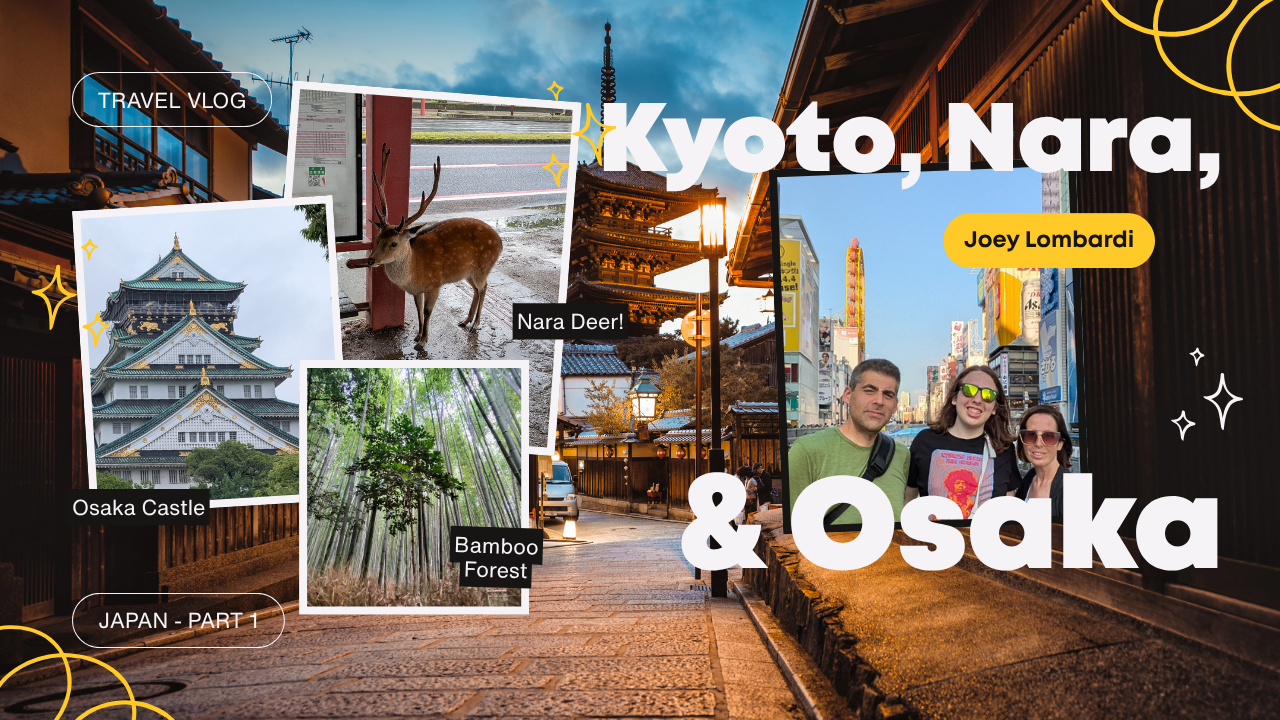
Our Osaka, Nara and Kyoto itinerary was the first stage of a three-part family trip through Japan. After arriving in Tokyo, we traveled by bullet train to Osaka and used the city as our base for visiting Nara, Kyoto and the surrounding Kansai region.
This was an interesting way to begin the trip. Nara was one of our first major highlights, while our experiences in Kyoto and central Osaka were more mixed. However, one thing impressed me from the moment we arrived: Japan’s incredible public transportation system.
In this article, I will share what we did, what we enjoyed, what felt overly touristy and what we might do differently on a future trip.
Traveling From Tokyo to Osaka by Bullet Train
Almost immediately after arriving in Japan, we had to figure out how to travel from Tokyo to Osaka. We were tired, carrying luggage and completely unfamiliar with the stations. Despite that, the process was much easier than I expected.
Taking the Shinkansen, or Japanese bullet train, made traveling between two of Japan’s largest metropolitan areas feel remarkably practical. Instead of losing an entire day to another airport experience, we boarded the train in Tokyo and continued directly to Osaka.
Japan’s rail system became the foundation of this entire portion of our trip. We used trains to travel around Osaka and to make day trips to both Nara and Kyoto. At no point did I feel as though we needed to rent a car.
The trains were frequent, clean and connected directly to the neighborhoods and attractions we wanted to visit. The system was not always simple at first glance, especially inside the larger stations, but it was extremely functional.
It made me jealous that the United States does not have anything comparable. Japan does not simply have public transportation. Its cities and communities feel as though they were actually designed around people using it.
Our House in Osaka’s Korea Town
We stayed in Osaka’s Korea Town area in a small house located close to a train station. The location worked very well as a base for exploring the Kansai region.
The house was small by American standards, but it used the available space efficiently. It had four bedrooms, which gave everyone some privacy, and two bathrooms, which was extremely helpful when four people were trying to get ready in the morning.
The main weakness was the lack of common space. It was a good house for sleeping, showering and preparing for the day, but it was not a place where everyone could comfortably gather in one room at night.
Ultimately, being close to the train station mattered more than having a large living room. Most mornings, we left the neighborhood and spent the day exploring another part of Osaka or another city entirely.
It was a good home base, but it was not necessarily a great “hangout house.”
Taking a Day Trip From Osaka to Nara
Nara was one of the best surprises during the first stage of our Japan trip.
We deliberately arrived early because we wanted to avoid the largest crowds. That decision made a major difference. Nara felt calmer and more historic than the busy entertainment districts we encountered in Osaka and Kyoto.
Nara served as the capital of Japan from 710 to 784, and the area contains some of the country’s most important early Buddhist temples and historic sites.
It was also very easy to reach by train from Osaka. That accessibility makes Nara an excellent addition to an Osaka, Nara and Kyoto itinerary, even for travelers who do not want to change hotels.
Meeting the Famous Deer in Nara Park
The deer are probably the most recognizable feature of Nara. They walk freely through the park, temple grounds and nearby pedestrian areas.
Although the deer are accustomed to people, they are still wild animals. Visitors can purchase special deer crackers called shika senbei from vendors throughout the park.
At first, the deer appear extremely calm and polite. Some will even bow in anticipation of receiving a cracker. However, once they realize you are carrying food, the situation can change quickly.
The deer can become very assertive when they want more crackers. They may surround you, nudge you, pull at your clothing or continue following you after you have fed them.
It was mostly funny for us, but I could understand how a smaller child might become overwhelmed. The deer were extremely polite until they realized we had food.
Once you run out of crackers, it helps to show the deer your empty hands so they understand that the food is gone.
Visiting Tōdai-ji Temple in Nara
After walking through Nara Park, we continued to Tōdai-ji Temple. This was one of the strongest historical experiences from the first portion of our trip.
The Great South Gate
Before reaching the main temple, visitors pass through Nandaimon, also known as the Great South Gate.
The present gate was completed in 1203 and stands approximately 84 feet high. Its exposed wooden structure and enormous support pillars immediately communicate the scale of the temple complex.
Inside the sides of the gate are two massive guardian statues known as the Niō, or Two Kings. Each guardian is approximately 28 feet tall.
The muscular figures have intense facial expressions and dramatic poses. Their purpose is to protect the temple grounds and repel evil.
According to Tōdai-ji, the statues were completed in only 69 days under the direction of the master sculptors Unkei and Kaikei. Considering their size and level of detail, that is difficult to comprehend.
The Great Buddha Hall
The main building at Tōdai-ji is the Daibutsuden, or Great Buddha Hall.
Earlier versions of the hall were destroyed by fire. The present structure dates from the early 18th century and was completed in 1709.
The current building is enormous, but it was actually constructed narrower than the previous version because the temple did not have sufficient funding to rebuild it at its original size.
That was one of my favorite facts from the visit. The building we saw was massive, yet it was still smaller than the versions that stood there centuries earlier.
The Great Buddha and Other Statues
At the center of the hall is a monumental bronze representation of Vairocana Buddha. The statue is approximately 49 feet tall.
The scale is difficult to understand in photographs. It becomes much more apparent when you see people standing near the base of the statue.
The peaceful expression of the central Buddha contrasts with the more dramatic guardian figures located elsewhere inside the hall. Even without understanding every element of Buddhist symbolism, the size, age and craftsmanship make the building impressive.
Tōdai-ji gave us our first real sense of the historical scale of Japan. Combined with the deer and the relaxed atmosphere of the park, it made Nara one of the highlights of our Kansai itinerary.
Our Day in Kyoto and Arashiyama
The following day, we took the train from Osaka to Kyoto. We focused primarily on the Arashiyama area, including the Bamboo Grove, Tenryū-ji Temple, Togetsukyō Bridge and the surrounding commercial streets.
Kyoto was a more complicated experience for us. I am glad we visited, but I do not think we selected the parts of Kyoto that would have appealed to us most.
Walking Through the Arashiyama Bamboo Grove
The Arashiyama Bamboo Grove is one of Kyoto’s most photographed locations. The tall bamboo looks particularly impressive when you point the camera upward and capture the stalks forming a canopy above the path.
However, the experience on the ground was not as quiet or isolated as many photographs make it appear.
The path was busy, relatively narrow and clearly part of a major tourist route. Rather than feeling as though we had entered a remote bamboo forest, it felt like we were moving through a famous photography location with a large number of other visitors.
It was worth seeing once, but it was more tourist-oriented than we expected.
Exploring Tenryū-ji Temple
We also visited Tenryū-ji Temple, a major Zen temple founded in 1339.
One of its most important features is its historic garden, which incorporates a design technique known as borrowed scenery. The mountains and hills behind the temple are intentionally framed as part of the garden’s composition.
The garden becomes more interesting once you understand that it is not limited to the pond, stones and trees directly in front of you. The distant landscape is also part of the design.
I could appreciate the history and thought behind it, although it was not necessarily a personal highlight of the trip.
Crossing Togetsukyō Bridge
After leaving the temple and bamboo grove, we walked across Togetsukyō Bridge.
The bridge crosses the Katsura River with the Arashiyama mountains in the background. It has been a recognizable landmark in the area for centuries.
The river, bridge and mountains created an attractive scene. However, the commercial streets around the bridge reinforced our impression that we had selected one of Kyoto’s most heavily visited tourism districts.
The area was filled with pedestrians, souvenir stores, restaurants and snack shops. Instead of feeling immersed in historic Kyoto, we felt as though we were following a highly concentrated tourist route.
I do not think Kyoto itself was the problem. Kyoto is a large city with many temples, neighborhoods and historic areas. I think our choices focused too heavily on the attractions that appear most often in social media posts and first-time visitor guides.
I am glad we went, but I would build a different Kyoto itinerary if we returned.
Trying a Proper Yakiniku Lunch in Osaka
Back in Osaka, we had lunch at a proper yakiniku restaurant.
Yakiniku is a Japanese tabletop grilling experience. Small cuts of meat are brought to the table, and diners cook each piece themselves using a grill built directly into the table.
The meal was interactive, and everyone could cook the meat according to their own preferences. It also naturally slowed the meal down because we were cooking and eating a few pieces at a time.
This was one of our more memorable meals during the Osaka portion of the trip. However, I will cover our experiences eating in Japan in a separate article and video because the food deserves its own discussion.
Dotonbori Canal and Namba at Night
One of the most visually interesting parts of our Osaka visit was taking a nighttime boat cruise along the Dotonbori Canal.
Dotonbori is located in Osaka’s Minami entertainment district near Namba. The area is known for its canal, bridges, restaurants, enormous signs and bright neon displays.
Taking the cruise at night was the right decision. From the water, we could appreciate the lights, signs and reflections without constantly pushing through the crowds on the surrounding streets.
The boat passed underneath several bridges and provided a different perspective on the district. The neon reflections across the canal made Dotonbori look much more impressive from the water than it did at street level.
The canal cruise was probably my favorite part of exploring central Osaka.
Walking Around Dotonbori and Namba
After the canal cruise, we walked through the surrounding Dotonbori and Namba streets.
The area was extremely crowded, bright and loud. The oversized signs were entertaining, particularly the giant mechanical seafood displays attached to many of the buildings.
However, after walking around for a while, the restaurants and food stalls began to feel repetitive. We repeatedly saw variations of the same popular foods, including takoyaki, grilled meat, skewers and other recognizable street-food options.
Dotonbori reminded me of a Japanese version of the Wildwood boardwalk in New Jersey. It was packed with people, covered in bright signs and filled with businesses selling variations of the same handful of foods and attractions.
That atmosphere will appeal to many visitors, especially people seeking nightlife and street food. For me, it was entertaining for a while, but it was not necessarily what I had hoped to experience in Japan.
I also want to be fair to Osaka. Dotonbori and Namba do not represent the entire city. We began our trip in one of Osaka’s most famous and heavily visited entertainment districts while we were still tired and adjusting to Japan.
I do not think I disliked Osaka as a city. I think the parts of Osaka we selected were designed for the highest possible volume of visitors.
Our Honest Impressions of Osaka, Nara and Kyoto
This first portion of our trip produced three very different reactions.
Nara Was the Surprise Highlight
Nara was historic, approachable and easy to reach from Osaka. The deer made the day entertaining, while Tōdai-ji provided one of our first major encounters with Japan’s ancient architecture and religious history.
Arriving early helped us avoid some of the crowds and made the area easier to appreciate.
Kyoto Deserves a Better-Planned Return Visit
Kyoto was beautiful, but our Arashiyama itinerary felt overly concentrated around famous tourist attractions.
The Bamboo Grove, Tenryū-ji and Togetsukyō Bridge were worth seeing, but I would explore quieter temples and neighborhoods during a future visit.
Osaka Was a Mixed Experience
We enjoyed the yakiniku lunch and Dotonbori Canal cruise. However, the busiest parts of Dotonbori and Namba felt crowded, repetitive and more tourist-oriented than we expected.
I would need to explore Osaka’s residential neighborhoods and less famous districts before making a final judgment about the city.
Japan’s Transportation Was Outstanding
The unquestioned success of our Osaka, Nara and Kyoto itinerary was Japan’s transportation system.
We traveled from Tokyo to Osaka by bullet train, moved around Osaka on local trains and completed day trips to both Nara and Kyoto without a car.
The system gave us the freedom to explore several cities while continuing to use the same house as our base. It was efficient, practical and one of the things I most wished we could replicate in the United States.
Would We Recommend This Osaka, Nara and Kyoto Itinerary?
Yes, but I would make a few adjustments.
- Keep Nara: It was one of the best experiences from this stage of the trip.
- Keep the Dotonbori Canal cruise: The area looked best from the water at night.
- Choose a broader Kyoto itinerary: Combine one famous attraction with a quieter temple or neighborhood.
- Explore more of Osaka: Do not limit the experience to Dotonbori and central Namba.
- Stay close to a train station: Convenient transit access was more valuable than having a large rental house.
This was a memorable and occasionally surprising beginning to our Japan trip. The next stage took us away from the crowded cities of Kansai and into Sapporo and the wider Hokkaido region, which felt like an entirely different side of Japan.
Frequently Asked Questions
Can you visit Nara as a day trip from Osaka?
Yes. Nara is easy to reach by train from Osaka and works very well as a day trip. Visitors can explore Nara Park, see the deer and visit Tōdai-ji without changing hotels.
Do the deer in Nara become aggressive?
The deer are generally accustomed to visitors, but they can become pushy when they see food. They may nudge people, pull at clothing or gather around anyone carrying deer crackers. Remember that they are still wild animals.
Is the Arashiyama Bamboo Grove worth visiting?
The bamboo grove is visually distinctive and worth seeing once, but it can become crowded. Arriving early may provide a quieter experience.
Is Dotonbori better during the day or at night?
Dotonbori is particularly impressive at night when the signs and buildings are illuminated. A canal cruise provides excellent views of the neon lights and reflections from the water.
Do you need a car to visit Osaka, Nara and Kyoto?
No. Japan’s train system makes it practical to travel between Osaka, Nara and Kyoto without renting a car. Staying near a train station makes the experience even easier.