

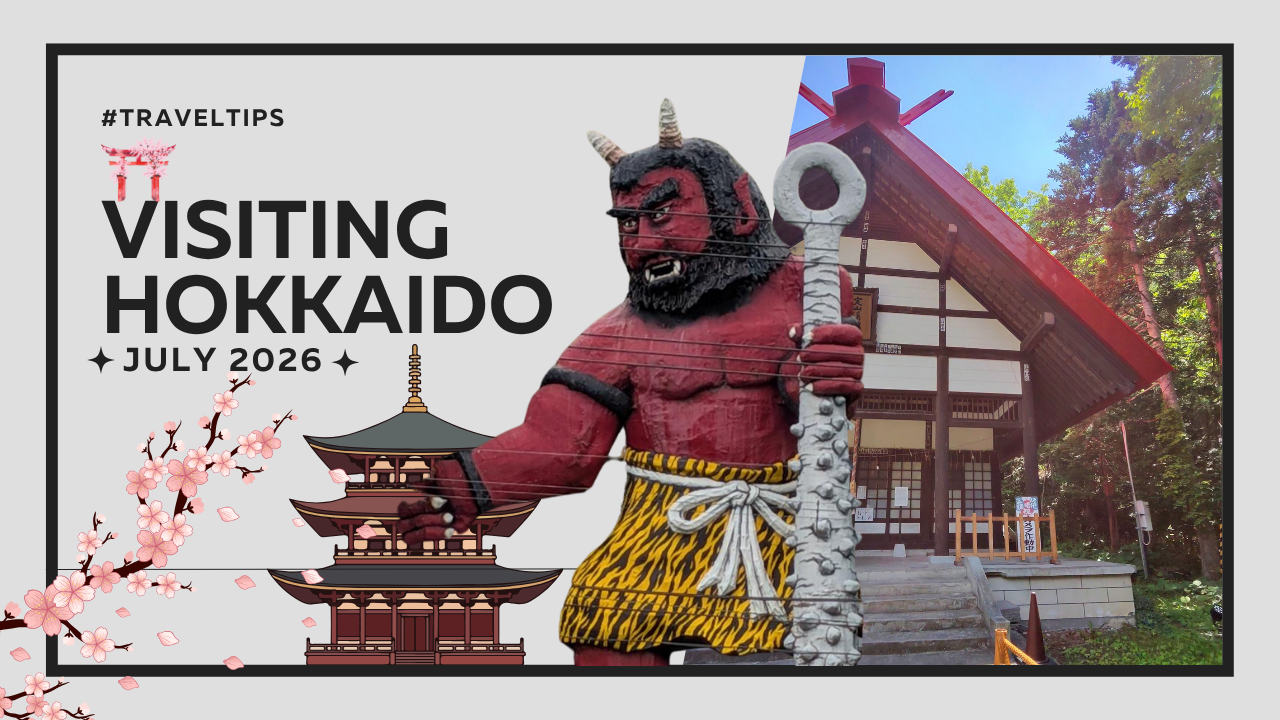
Our Hokkaido road trip itinerary showed us a completely different side of Japan. After several days of crowded streets, famous temples and busy train stations around Osaka and Kyoto, Hokkaido gave us cooler summer weather, open roads, mountain scenery, hot springs and some of our favorite accidental discoveries of the trip.
We flew from Osaka to Sapporo, rented a car and spent three days exploring Lake Shikotsu, the Hill of the Buddha, Noboribetsu, Jozankei and Hōheikyō Dam.
Driving on the left side of the road was stressful, especially during our first day. However, renting a car ultimately changed the entire experience. It allowed us to reach places outside central Sapporo, change our plans when the weather interfered and discover locations we probably would not have visited by train.
This article covers our three-day Hokkaido itinerary, what it was like driving in Japan, the places we enjoyed most and the practical lessons we learned along the way.
Do You Need a Car for a Hokkaido Road Trip?
You can visit central Sapporo without renting a car. The city has trains, buses and a subway system, and many popular urban attractions are accessible by public transportation.
However, a car made an enormous difference for the particular trip we wanted to take.
Our itinerary included a volcanic lake, an unusual cemetery and sculpture park, a hot-spring town, a private onsen and a mountain dam. Some of these destinations can be reached using buses, but coordinating all of them over a short visit would have been much more difficult.
The Japan National Tourism Organization specifically notes that Hokkaido is more accessible by car than many other parts of Japan.
The car also gave us flexibility. When boat operations at Lake Shikotsu were canceled because of strong winds, we could adjust our plans and continue to another destination. It also allowed us to visit Noboribetsu without having built the entire day around train and bus schedules.
For our Hokkaido road trip itinerary, the freedom was ultimately worth the stress.
International Driving Permit Requirements
Travelers should confirm Japan’s driving-document requirements before leaving home. Many visitors, including drivers from the United States, need a valid International Driving Permit in addition to their regular driver’s license and passport.
An International Driving Permit generally must be obtained before arriving in Japan. Requirements vary depending on the country that issued your license, so check the current official rules before booking a rental car.
Day 1: Flying to Sapporo and Adjusting to the Rental Car
We flew from Osaka to New Chitose Airport and collected our rental car after retrieving our luggage.
Coming from the United States, driving on the opposite side of the road required an immediate mental adjustment. The steering wheel was on the right side of the vehicle, traffic moved on the left and nearly every instinct I had developed over decades of driving felt reversed.
The roads were not necessarily difficult. The stressful part was having to think consciously about actions I would normally perform automatically.
Turns required the most concentration. I had to remind myself which lane to enter, where traffic would be coming from and how to position the vehicle after completing the turn.
I also had to relearn how to judge the width of the car. Sitting on the opposite side changed my sense of where the passenger side of the vehicle was located.
Checking Into Our Sapporo Airbnb
After leaving the airport, we drove to our Airbnb, unloaded our luggage and tried to get familiar with the surrounding neighborhood.
We found a grocery store, purchased food and supplies and walked around the area to get our bearings. Between the flight, rental-car process, check-in and grocery shopping, most of the day was already gone.
This was more of an adjustment day than a sightseeing day.
Why Parking Matters in Sapporo
One of the most important lessons from our Hokkaido road trip was to confirm parking before booking accommodations.
Do not assume that an Airbnb or hotel will automatically include a place to leave the car. Street parking may not be available, and nearby paid parking can add expense and inconvenience.
Our rental included a parking space, which made returning at night much easier. I would treat onsite parking as an essential accommodation feature rather than an optional bonus.
Parking outside the city was generally manageable. Driving and finding parking in downtown Sapporo was much more stressful, especially while I was still adjusting to the car.
Dinner in Downtown Sapporo
We ended our first day at a yakiniku restaurant in downtown Sapporo.
The meal was enjoyable, but I was exhausted from flying, driving, navigating and trying to understand the parking system. By the time we sat down, I was mentally burned out.
That evening made me suspect that driving through rural Hokkaido would be much easier than driving through central Sapporo. The following day confirmed it.
Day 2: Visiting Lake Shikotsu
Our first major road-trip destination was Lake Shikotsu.
This was the moment when Hokkaido began to feel completely different from the earlier stages of our Japan trip. Instead of crowded commercial streets, we found open water, surrounding mountains and a much quieter atmosphere.
Lake Shikotsu is a volcanic caldera lake that formed through volcanic activity approximately 40,000 years ago. It has a maximum depth of about 360 meters, or 1,180 feet, making it Japan’s second-deepest lake.
The lake is also known for its unusually clear water and distinctive blue appearance, often called “Shikotsu Blue.” It is surrounded by mountains and forests within Shikotsu-Tōya National Park.
When the Weather Changes Your Plans
We planned to take a boat onto the lake, but strong winds caused boat operations to shut down for the day.
That was disappointing, but it also reinforced an important lesson about planning outdoor activities in Hokkaido: the weather still gets the final vote.
A flexible itinerary is useful. Even though we could not go onto the water, Lake Shikotsu was still worth visiting for the scenery alone.
We walked around the lakeshore, explored the surrounding area and spent time taking in the mountain views. This was one location where the footage could speak for itself because nearly every direction offered another impressive view.
The Beginning of Ben’s Daily Ice-Cream Tradition
Lake Shikotsu was also where Ben discovered Hokkaido’s dairy products and local soft-serve ice cream.
That one stop began a pattern. From this point forward, he managed to find ice cream almost every day of the trip.
What began as a snack at Lake Shikotsu gradually turned into an unofficial Japan ice-cream tour.
The Hill of the Buddha Near Sapporo
After leaving Lake Shikotsu, we drove to the Hill of the Buddha at Makomanai Takino Cemetery.
Before visiting, I assumed it was simply a large Buddha statue built as a tourist attraction. The full setting was more unusual and more interesting than expected.
Makomanai Takino Cemetery is still an active burial place, but it was also designed as a park-like public space where visitors can gather, rest and appreciate the surrounding architecture and landscape.
The property includes the Hill of the Buddha, enormous Moai-style statues, a Stonehenge-inspired memorial, cafés, gardens and other sculptures.
It feels like a combination of cemetery, memorial park, architectural attraction and sculpture garden.
The Moai Statues
The first major surprise was a row of enormous Moai-style statues near the entrance.
They resemble the famous statues of Easter Island, but these are modern sculptures created for the cemetery. According to the cemetery, they symbolize preserving and passing the evidence of people’s lives to future generations.
The largest statue stands approximately 9.5 meters high and weighs around 120 tons. The others are approximately 6.5 meters high and weigh about 60 tons.
Seeing a line of giant Moai statues in Hokkaido felt surreal. They immediately established that this would not be a conventional religious or memorial site.
The Architectural Reveal of the Buddha
The Hill of the Buddha was designed by renowned Japanese architect Tadao Ando and completed in 2016.
The Buddha statue already existed, but Ando transformed how visitors approach and experience it. Instead of leaving the full statue visible in the open, he surrounded it with an artificial hill covered by lavender.
From a distance, only the Buddha’s head is visible above the landscape.
Visitors follow a 135-meter approach, move around a water garden and enter a dim concrete tunnel approximately 40 meters long. The full statue is revealed only after emerging from the tunnel into the open rotunda.
The Buddha stands approximately 13.5 meters, or 44 feet, high.
The most effective part is not simply the statue’s size. The entire route builds anticipation and controls when visitors finally see it.
It is not just a giant Buddha. It is an intentionally designed experience.
The Unexpected Japanese Garden
After seeing the enormous Buddha and the Moai statues, the location our family kept discussing was a small Japanese garden near the café.
The garden was quiet, carefully proportioned and separated from the scale of the surrounding monuments. We all agreed that it was oddly fantastic.
The official cemetery information identifies the garden as another space designed by Tadao Ando.
The giant attractions gave us a reason to visit, but the small garden may have been the place where we most wanted to remain.
Noboribetsu: Our Favorite Accidental Discovery
Noboribetsu was not originally one of the major destinations on our Hokkaido itinerary.
Because we had the rental car, we were able to make an unplanned detour and explore the town. It became my favorite accidental discovery of the entire Japan trip.
Noboribetsu Onsen is one of Hokkaido’s best-known hot-spring communities. Much of its hot water comes from the volcanic landscape surrounding Jigokudani, commonly translated as Hell Valley.
Hell Valley is a volcanic crater filled with vents, steam and bubbling water. Approximately 10,000 tons of hot-spring water flow from the area each day and supply local hotels and inns.
Why Does Noboribetsu Have a Demon Theme?
The town fully embraces demon imagery. Visitors encounter demon statues, decorations and references to hell throughout the streets.
The theme is connected to Jigokudani rather than being a random tourist gimmick.
Local legends say that demon gods called Yukijin inhabit Hell Valley and guard the medicinal hot springs. The demons are therefore presented as protectors rather than simply as evil monsters.
Once we understood that connection, the decorations felt more like part of a coherent local identity.
Why We Enjoyed Noboribetsu
Noboribetsu was small enough to explore without feeling overwhelmed.
We parked, walked around the main street, looked at the demon statues and explored the hot-spring area. There was no pressure to complete a long checklist of famous attractions.
The town had a memorable personality, but it did not feel like the same attraction repeating on every block.
I also think arriving without expectations improved the experience. We had not spent months studying every landmark or building an elaborate schedule. We simply decided to stop and see what was there.
Sometimes the place you spend the least time planning becomes the place you remember most.
Day 3: Finding a Private Onsen Near Sapporo
Before traveling to Japan, I wanted to experience an onsen. However, finding the right place for our first visit was more complicated than expected.
We needed a facility that accepted day visitors, allowed reservations and offered a private bathing space.
Traditional public onsen have established customs, and we did not want our first experience to involve entering a public bath while feeling uncertain about the process.
ChatGPT helped me locate Yumoto Koganeyu, southwest of central Sapporo.
The facility offers public indoor and outdoor baths, saunas, onsite parking and privately reserved bathing rooms.
It was not an elaborate luxury resort, but the staff were extremely welcoming. The private space allowed us to learn the process, relax and avoid worrying that we were accidentally breaking a rule in front of other guests.
Once we were inside, the experience was much simpler than all of the preparation made it seem.
It may not have been the fanciest onsen available, but it was probably the right first onsen experience for our family.
A Quick Stop at Jozankei Shrine
After the onsen, we made a brief stop at Jozankei Shrine.
The shrine was built in 1905 and stands in the hills overlooking the Jozankei hot-spring area. It is connected to the early settlers who protected and helped develop the therapeutic baths established by Miizumi Jozan, the founder of Jozankei Onsen.
The main shrine building was reconstructed in 1918 using unfinished wood in the traditional Shinmei-zukuri architectural style.
This was not a major destination on the scale of the temples we visited in Nara or Kyoto. It felt more closely connected to the surrounding community.
We did not stay long, but it provided a peaceful stop before continuing farther into the mountains.
Hōheikyō Dam: The Quiet Final Surprise
Our last major destination was Hōheikyō Dam.
We knew almost nothing about the dam before arriving. We parked, completed the final approach and discovered a huge mountain landscape with almost no other tourists around.
After spending part of the trip in some of Japan’s busiest cities, standing in a quiet valley beside such a major structure felt remarkable.
Hōheikyō is a curved concrete arch dam located approximately seven kilometers upstream from Jozankei Onsen. It stands 102.5 meters, or about 336 feet, high and spans approximately 305 meters.
The surrounding Toyohira River system is an essential water source for Sapporo, supporting approximately 98% of the city’s water needs.
More Than an Engineering Attraction
The dam itself was impressive, but the surrounding landscape was equally memorable.
From the viewing areas, we could see the reservoir, curved dam wall, forested mountains and deep valley below.
It felt like a major tourist attraction that everyone had somehow forgotten to visit that day.
Hōheikyō Dam reinforced a pattern we noticed throughout Hokkaido. Some of the best experiences were not necessarily the locations we had researched most carefully. They were places we found because we had a car, saw something interesting and continued down the road.
We knew almost nothing about Hōheikyō Dam before arriving, but it provided some of the best views and quietest moments of the trip.
Our Honest Impressions of Sapporo and Hokkaido
We loved our time in Hokkaido.
Visiting during the summer gave us a welcome break from the heat and humidity we experienced farther south. The more comfortable weather made spending time outdoors much easier.
Hokkaido also felt more open. Instead of organizing every day around train stations and crowded tourism districts, we drove through mountain roads, visited a volcanic lake, explored a small hot-spring town and found scenic locations with relatively few visitors.
The Rental Car Was Stressful but Worthwhile
Driving was especially stressful during the first day and whenever we entered downtown Sapporo.
Outside the city, however, the car gave us access to a much wider area. It also allowed us to change plans without worrying about missing the final train or waiting for an infrequent bus.
You can visit Sapporo without a vehicle, but we could not have recreated this particular itinerary as easily without one.
Hokkaido Rewarded Flexibility
Not everything went according to plan.
The boat operations at Lake Shikotsu were canceled. Noboribetsu was not originally a major destination. We knew almost nothing about Hōheikyō Dam before arriving.
Those changes and accidental discoveries became part of what made the trip memorable.
Our Favorite Hokkaido Experiences
- Best natural scenery: Lake Shikotsu and Hōheikyō Dam
- Best unexpected destination: Noboribetsu
- Most unusual attraction: Hill of the Buddha and the Moai statues
- Best quiet space: The small Japanese garden at Makomanai Takino Cemetery
- Most useful first-time experience: The private bath at Yumoto Koganeyu
- Most consistent daily activity: Ben finding another ice cream
Practical Hokkaido Road Trip Tips
Confirm Your Driving Documents Before Traveling
Check whether you need an International Driving Permit and obtain it before leaving your home country. Carry your passport, regular driver’s license and any required permit or translation.
Book Accommodations With Parking
Do not assume parking is included. Confirm that your hotel or rental has a legal onsite space before completing the reservation.
Allow Time to Adjust to Driving on the Left
Avoid making your first drive more complicated than necessary. A simple route outside rush hour may be preferable to immediately navigating central Sapporo.
Research Parking Before Entering Downtown Sapporo
Choose a parking facility before leaving rather than circling unfamiliar streets after arriving. Coin-operated lots are common, but the systems and payment procedures can differ.
Keep the Itinerary Flexible
Wind, rain and other weather conditions can affect lake activities and mountain attractions. Have a backup destination or be willing to change the order of the day.
Do Not Schedule Every Minute
Some of our favorite stops were unplanned. Leave enough time to investigate a town, viewpoint or attraction that looks interesting along the way.
Would We Recommend This Hokkaido Road Trip Itinerary?
Yes. This was one of our favorite portions of the entire Japan trip.
The itinerary combined natural scenery, unusual architecture, hot-spring culture and small destinations with distinct personalities.
The car created additional work and stress, but it also gave us the freedom to experience Hokkaido in a way that would have been difficult using public transportation alone.
For travelers who are comfortable driving internationally, a road trip can be an excellent way to explore the areas surrounding Sapporo.
After three days of lakes, mountains, hot springs, demon statues and quiet roads, we returned the rental car and flew to Tokyo for the largest, busiest and longest portion of our trip.
Official Sources and Further Information
- Japan National Tourism Organization: Renting a Car in Japan
- Hokkaido Tourism Organization: Lake Shikotsu
- Makomanai Takino Cemetery Visitor Information
- Official Hill of the Buddha Information
- Noboribetsu Onsen Tourism Association
- The Demons of Noboribetsu
- Jozankei Tourism Association: Yumoto Koganeyu
- Jozankei Shrine
- Hokkaido Tourism Organization: Hōheikyō Dam