

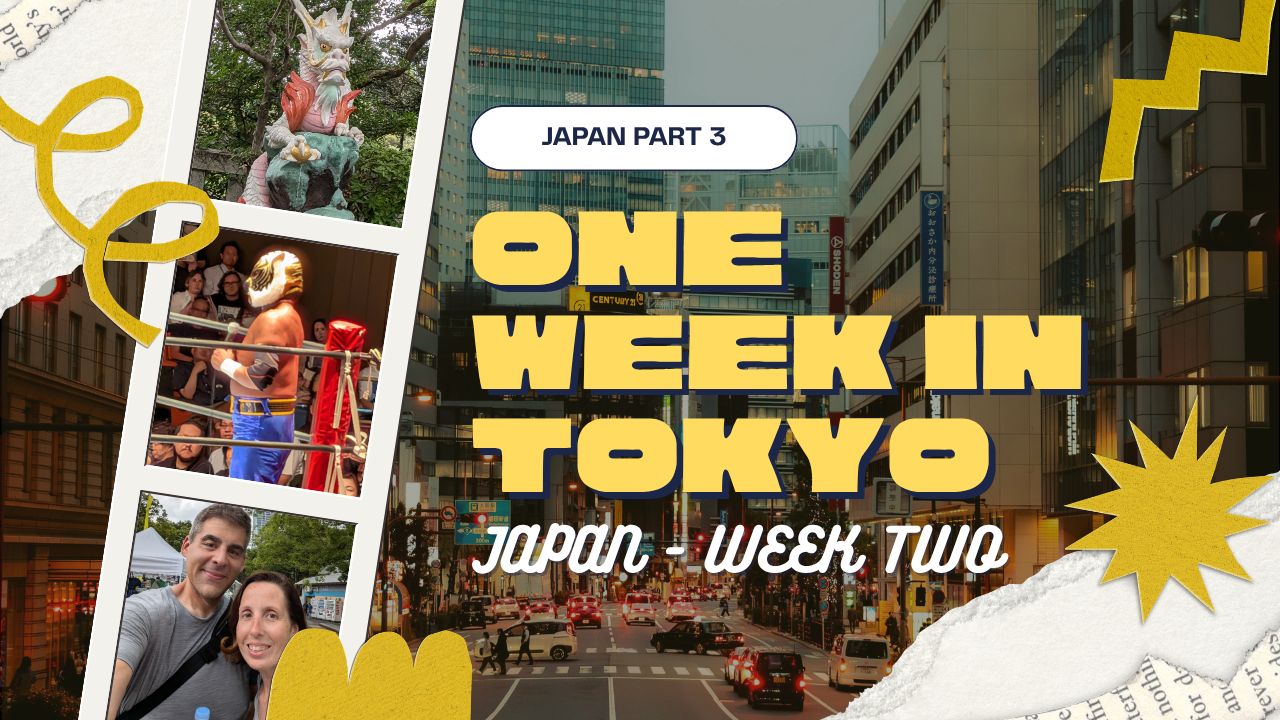
Our Tokyo travel itinerary was the longest and most varied part of our family trip through Japan. After visiting Osaka, Kyoto, Nara, Sapporo and the wider Hokkaido region, we spent nearly a week using Tokyo as our base.
During that time, we explored futuristic digital art, restaurant-supply stores, high-end shopping districts, historic gardens and a legendary professional wrestling venue. We also took day trips to Kamakura, Enoshima and Kawagoe.
Tokyo was surprisingly easy to navigate. The train and subway maps looked intimidating at first, but the system became familiar quickly. We occasionally used taxis when carrying luggage or large shopping bags, but public transportation handled almost everything else.
Not every famous attraction impressed us. In fact, my favorite day began with an accidental muddy hike outside the city. However, Tokyo provided the broadest mix of experiences from our entire Japan trip.
Arriving in Tokyo and Settling Into Our Rental House
Our first day in Tokyo followed the same pattern as our arrival days in Osaka and Sapporo. We traveled, collected our luggage, reached the rental house, unpacked and searched for dinner.
There was no major attraction that day. After moving between regions, everyone needed time to understand the new house and surrounding neighborhood.
The most memorable part of the evening was eating at a restaurant in Shinjuku that used a robot delivery system.
The robot carried food from the kitchen area to the table, allowing the human staff to focus on ordering, customer questions and other parts of the service. It was practical, but it also provided one of those futuristic moments many travelers expect to encounter in Japan.
After a full travel day, our first Tokyo meal was delivered by a robotic cat.
Day 2: teamLab Planets in Toyosu
Our first major Tokyo attraction was teamLab Planets in Toyosu.
Visitors remove their shoes and move through a series of rooms containing water, mirrored surfaces, projections, flowers and interactive digital artwork.
The opening water-based section was the strongest part of the experience for me. We walked barefoot through warm water while projected koi moved around our legs. The fish changed direction in response to the people in the room and transformed into flowers when they collided with visitors.
That section felt genuinely interactive rather than simply decorative.
Does teamLab Planets Look Better on Video?
After the water exhibit, my enthusiasm declined.
The other rooms looked visually impressive, but the crowds made it difficult to become fully absorbed in the experience. Even with timed admission, we waited in substantial lines and frequently felt aware of people taking photographs or moving into the next space.
Interestingly, the attraction looks fantastic in our footage. The mirrors, projections and lights appear dramatic once the surrounding noise and crowd management are removed.
That created a strange disconnect between the video and my actual memory of being there.
teamLab Planets may be one of those attractions that looks better on camera than it feels in person. I understand why people enjoy it, but the water section set a high standard that the later rooms did not match for me.
Ryan and the Fruit Vendor
Outside teamLab, Ryan stopped to speak with a local fruit vendor he had apparently met before.
I joked that there was no possible way the vendor remembered him. Ryan had been one customer among thousands of visitors passing through the area.
The vendor then appeared to recognize him.
Toyosu Senkyaku Banrai
After teamLab, we visited Toyosu Senkyaku Banrai, a food and shopping complex near Toyosu Market.
The property recreates the appearance of an Edo-period commercial neighborhood. Wooden-style façades, lanterns and narrow storefronts create a historical atmosphere even though the complex is modern.
Restaurants and food stalls focus heavily on Japanese seafood and dishes connected to Tokyo’s historic market culture. We found several good things to eat and enjoyed walking through the reconstructed streets.
This was easier to enjoy casually than teamLab. We did not have to interpret the attraction or wait for entry into another room. We could simply explore, find food and continue when we were ready.
Shibuya Shopping and an Unexpected Outdoor Market
Ryan wanted to visit Shibuya, while he and Ben were primarily interested in anime-related stores and merchandise.
Allison and I allowed them to shop while we explored the surrounding area. We unexpectedly discovered an outdoor market with food trucks, handmade items and small independent vendors.
The market felt relaxed and gave us a break from department stores and heavily promoted tourist attractions. We walked among the stalls, looked at the handmade products and watched food being prepared in the trucks.
This became another example of an unplanned activity being more enjoyable than something we had researched carefully.
Day 3: Shopping for a Japanese Knife in Kappabashi
The next day had a very specific mission: finding a quality Japanese kitchen knife for my father, also known as Mean Joe.
We traveled to Kappabashi-dōri, Tokyo’s famous restaurant-supply district.
Kappabashi is filled with stores selling:
- Japanese knives
- Cookware and kitchen tools
- Plates, bowls and ceramics
- Restaurant furniture and signs
- Commercial kitchen equipment
- Plastic replica food displays
The district serves restaurant professionals, but it has also become popular with travelers searching for Japanese knives, ceramics and practical kitchen souvenirs.
Buying a Knife at Kamata Hakensha
We eventually found Mean Joe’s knife at Kamata Hakensha.
Kamata began as a knife-sharpening business in 1923 and has continued through several generations. The store carries a large range of Japanese and Western-style kitchen knives.
Choosing the knife involved more than selecting the most expensive or visually impressive blade. We considered its intended use, weight, handle and overall feel.
During our visit, the tax-refund process was not completed directly at the store. We had to walk several blocks to a separate refund counter with the purchase, passport and receipt.
Travelers making tax-free purchases in Kappabashi should ask exactly where the refund is processed before leaving the store.
Practical Kappabashi Travel Tips
Kappabashi is useful, but it is not a conventional shopping mall.
We found relatively few obvious places to eat or use a public restroom. Many businesses cater to professional buyers who already know what they need and are not planning to spend the entire day in the district.
Before visiting Kappabashi:
- Eat before arriving or identify a restaurant in advance.
- Use a restroom before beginning your shopping.
- Carry water, especially during the summer.
- Bring your passport if you plan to request tax-free shopping.
- Research a few knife stores before arriving.
Ginza and the Tokyo Peak Design Store
After Kappabashi, we traveled to Ginza for higher-end shopping.
Ginza is known for luxury stores, major international brands, large department stores and polished flagship locations. We did not find anything especially compelling during our first visit, although we returned later in the trip.
One purposeful stop was the Peak Design store.
We purchased a new wallet for Ben and several packable bags. I also hoped to find a Tokyo-exclusive collectible pin from the store’s vending machine.
Unfortunately, the pin vending machine was no longer there during our visit.
I could buy the travel gear, but Tokyo had apparently decided that I was not getting another exclusive pin.
New Japan Pro-Wrestling at Korakuen Hall
That evening, we attended a New Japan Pro-Wrestling event at Korakuen Hall.
Korakuen Hall opened in 1962 and became one of Japan’s most important professional-wrestling and boxing venues. The building hosts hundreds of combat-sports events each year, including approximately 250 professional-wrestling shows.
The venue is much smaller than a modern arena. That compact design places the audience close to the ring and creates an energetic atmosphere.
I was already excited to attend a wrestling show in such a historic building. Then we discovered Hiroshi Tanahashi at the merchandise table.
Tanahashi is one of the most important wrestlers in NJPW history and currently serves as the company’s president. I could not believe that he was personally meeting fans and helping at the merchandise area.
Meeting him made the night even more memorable.
I was not permitted to film the wrestling itself, but the entire family enjoyed the show. Even family members who were not dedicated NJPW followers appreciated the energy and atmosphere inside Korakuen Hall.
Day 4: Our Favorite Tokyo-Area Adventure
Day four became my favorite day of the Tokyo portion of the trip, although most of it took place outside Tokyo.
We wanted to experience a Japanese beach, so we traveled into Kanagawa Prefecture and began the day in Kamakura.
The plan seemed simple: visit a temple, see a money-washing shrine, eat lunch and continue to the beach.
Instead, we accidentally turned the morning into a steep and extremely muddy hike.
Jōchi-ji Temple in Kita-Kamakura
Our first stop was Jōchi-ji Temple.
Jōchi-ji was founded in 1281 and ranks fourth among Kamakura’s Five Great Zen Temples. Chinese monks helped influence its early design, which explains some of the Song dynasty architectural details found in its buildings.
The temple grounds were peaceful and wooded. The pathways, structures and cemetery blended naturally into the surrounding hillside.
Its main hall contains three Buddha figures representing the past, present and future.
We also walked through the cemetery. Unlike a large urban cemetery, it felt integrated into the forest and temple grounds rather than separated from them.
Jōchi-ji was not the largest religious site we visited in Japan, but its quiet atmosphere made it one of the more pleasant.
Our Accidental Muddy Hike
After leaving Jōchi-ji, we tried to reach the famous money-washing shrine.
I read a sign, noticed a group of Japanese hikers following a trail and assumed they were traveling in the same direction.
They were. Unfortunately, they had selected the hiking route rather than the easy paved approach.
The trail became increasingly steep, muddy and slippery. Recent storms had made the conditions worse, and we were wearing ordinary walking shoes instead of hiking equipment.
Everyone’s shoes became covered in mud. Bugs attacked us throughout the climb, and the family’s enthusiasm for my navigation decisions declined rapidly.
At several points, we continued mainly because the properly equipped hikers ahead of us appeared confident.
When we finally reached the shrine, we discovered that a normal paved road provided a much easier route.
The hike was awful. Fortunately, the destination was completely worth it.
Zeniarai Benten: Kamakura’s Money-Washing Shrine
Zeniarai Benzaiten Ugafuku Shrine, commonly called Zeniarai Benten, became my favorite shrine of the entire trip.
According to tradition, Minamoto no Yoritomo founded the shrine in 1185 after the deity Ugafukujin appeared to him in a dream and revealed the location of a sacred spring.
The main entrance passes through a tunnel cut into the hillside. After walking through the rock, visitors emerge into an enclosed shrine complex surrounded by steep stone walls and trees.
The hidden setting made it feel as though we had discovered a sacred space inside the mountain.
Washing Money for Good Fortune
Visitors place coins or paper money into small baskets and wash them with water from the shrine’s spring.
Tradition says that money washed in the water may return or multiply through future financial good fortune. Another interpretation encourages visitors to spend the washed money rather than hide it permanently, allowing prosperity to continue circulating.
The activity gave everyone something active to do, but the shrine’s setting was more memorable to me than the promise of increased wealth.
I would gladly visit Zeniarai Benten again. I would simply use the paved road next time.
Lunch and a Japanese Beach
After the hike and shrine visit, everyone needed food and time to recover.
We ate lunch and continued toward the coast. Eventually, we reached the beach we had planned to visit from the beginning.
Fish were visibly jumping out of the water while we were swimming. After spending most of the morning covered in mud and bug bites, getting into the ocean felt like a reward.
Several local beach businesses offered paid showers, allowing us to clean up before continuing the day.
What began as a simple plan to see a beach had already included a Zen temple, a difficult hike, a shrine hidden inside a mountain and swimming among jumping fish.
We still had one more major stop.
Exploring Enoshima
After the beach, we continued to Enoshima.
The island combines narrow shopping streets, restaurants, ocean views, stairways and a large shrine complex spread across the hillside.
Enoshima Shrine traces its traditional origin to 552. The shrine complex includes three main sanctuaries:
- Hetsumiya
- Nakatsumiya
- Okutsumiya
The sanctuaries honor three sister goddesses associated with the sea and safe travel. Enoshima is also closely associated with Benzaiten, a deity connected to water, music, art and good fortune.
Reaching the higher sections required additional uphill walking, which was not ideal after our accidental morning hike. However, we enjoyed the atmosphere enough to continue exploring.
The gradual climb through shopping streets and shrine buildings made Enoshima feel like a complete destination rather than a single landmark.
Our day began with the goal of seeing a Japanese beach. It ended with a temple, a muddy mountain trail, a money-washing shrine, ocean swimming and an evening exploring Enoshima.
It was easily my favorite day of the Tokyo segment.
Day 5: Imperial Palace East Gardens and Shopping
After the Kamakura and Enoshima adventure, the family needed a less demanding day.
We planned to focus primarily on shopping, but we began with a historical stop at the Imperial Palace East Gardens.
The Imperial Palace East Gardens occupy the former Honmaru, Ninomaru and Sannomaru areas of Edo Castle. They opened to the public in 1968.
Ninomaru Garden
Ninomaru Garden provided open space and a quieter atmosphere in the center of Tokyo.
The traditional Japanese garden includes a pond, carefully arranged plants and walking paths. It offered a sharp contrast to the department stores and crowded train stations surrounding the palace grounds.
The Foundation of Edo Castle’s Main Keep
We also visited the massive stone foundation known as the Tenshudai.
This supported the main keep of Edo Castle, which once symbolized the power of the Tokugawa shogunate. The keep was destroyed during the Great Fire of Meireki in 1657 and was never rebuilt.
The remaining stone platform helps visitors understand how enormous the lost structure would have been.
Shopping in Shinjuku, Harajuku and Ginza
The rest of the day focused on shopping in Shinjuku, Harajuku and Ginza.
We did not find anything life-changing, but we purchased gifts, clothing and several items to bring home.
The slower schedule was useful. Not every vacation day needs to involve a major attraction or complicated route. A dedicated shopping day gave everyone time to find personal items without trying to fit stores between temples and scheduled events.
Day 6: A Final Day Trip to Kawagoe
For our final full day in Japan, we traveled to Kawagoe in Saitama Prefecture.
Kawagoe is often called “Little Edo” because of its preserved warehouse-style buildings, old merchant streets and historical connection to Edo-period Tokyo.
Our main stops were Kawagoe Hikawa Shrine, Kashiya Yokocho and the Toki no Kane bell tower.
Kawagoe Hikawa Shrine
Kawagoe Hikawa Shrine has a history of more than 1,500 years and traditionally served as a guardian shrine for the surrounding area.
The shrine is particularly associated with relationships, marriage and forming strong personal bonds.
Its large torii gate stands approximately 15 meters high and creates an impressive entrance to the property.
By the final day of the trip, we were more familiar with shrine layouts and customs. We better understood purification areas, offering boxes, prayer plaques and the differences between smaller community shrines and enormous temple complexes.
Candy Alley and the Unexpected Butter Sandwiches
We also visited Kashiya Yokocho, commonly known as Candy Alley.
The confectionery district began developing during the Meiji era. After the 1923 Great Kantō Earthquake damaged many Tokyo candy producers, businesses in Kawagoe helped supply sweets to the capital.
At its peak, the alley reportedly contained around 70 candy businesses.
I expected old-fashioned hard candy and traditional snacks. I was not prepared for the butter sandwiches.
The butter sandwiches were rich, sweet and unexpectedly excellent. After spending much of the trip trying to maintain a low-carb diet, Candy Alley provided a serious test of my commitment.
Nobody warned me that butter sandwiches were waiting to destroy my diet.
Toki no Kane Bell Tower
The Toki no Kane bell tower is one of Kawagoe’s most recognizable landmarks.
The tower has announced the time in the city since the early Edo period. The current structure is the fourth version and was rebuilt after the Great Fire of Kawagoe in 1893.
The bell still rings four times each day:
- 6:00 a.m.
- 12:00 p.m.
- 3:00 p.m.
- 6:00 p.m.
The tower rises above the surrounding historic buildings and provided an appropriate final historical image for our Japan trip.
Conveyor-Belt Sushi and a Failed Godzilla Finale
After returning from Kawagoe, we ate conveyor-belt sushi.
Sushi was more interesting to the rest of my family than it was to me, but the ordering screens and moving dishes made the restaurant experience entertaining.
We then attempted to end the trip by visiting the famous Godzilla head in Kabukichō.
The Godzilla head is located on the Shinjuku Toho Building, which also contains Hotel Gracery Shinjuku. It can be viewed from the surrounding streets, while closer terrace access depends on the building’s current policies and operating hours.
We arrived too late and were turned away.
After nearly two weeks of bullet trains, temples, mountain lakes, hot springs, wrestling, beaches and historic towns, our final attraction involved someone telling us that we could not see Godzilla.
It was an underwhelming ending, but it was also a very honest way to finish a complicated trip.
Our Honest Impressions of Tokyo
Tokyo was the easiest enormous city I have ever navigated without a car.
The transportation network looks overwhelming on a map, but the individual trips become manageable once you understand the lines, station numbers and transfer signs.
We occasionally used taxis when we had luggage, were carrying many shopping bags or needed to preserve time and energy. However, trains and subways remained our primary transportation.
Tokyo Felt Like Several Different Cities
Each area offered a different atmosphere:
- Toyosu: Modern, open and recently developed
- Shinjuku: Dense, bright and energetic
- Shibuya: Youthful, crowded and shopping-focused
- Ginza: Polished, expensive and brand-oriented
- Kappabashi: Practical, specialized and connected to working restaurants
- Imperial Palace area: Quiet, historic and spacious
The day trips added even more variety. Kamakura offered temples and shrines, Enoshima combined ocean views with religious history, and Kawagoe preserved the atmosphere of an older commercial town.
Our Favorite Tokyo-Area Experiences
- Best overall day: Kamakura, the beach and Enoshima
- Favorite shrine: Zeniarai Benten
- Best unexpected meeting: Hiroshi Tanahashi at Korakuen Hall
- Best specialty shopping: Kappabashi
- Most visually impressive on video: teamLab Planets
- Best accidental discovery: The outdoor market near Shibuya
- Best final-day food discovery: Kawagoe butter sandwiches
- Worst navigation decision: Following hikers to Zeniarai Benten
Would We Recommend This Tokyo Travel Itinerary?
Yes, although I would make a few adjustments.
Our Tokyo travel itinerary combined modern attractions, shopping, historic sites, entertainment and several day trips. That variety prevented the week from feeling repetitive.
I would still visit teamLab Planets, but I would arrive with realistic expectations about the crowds. I would also continue to include Kappabashi, Korakuen Hall, Kamakura, Enoshima and Kawagoe.
Most importantly, I would preserve some flexibility. Several of our best moments came from activities we did not plan carefully, including the outdoor market, Ryan’s fruit-vendor reunion and parts of the Kamakura adventure.
Tokyo did not give us one single defining experience. It gave us restaurant robots, digital art, kitchen knives, professional wrestling, historic gardens, beaches, shrines and old merchant towns.
It was the part of Japan where we finally understood how many completely different experiences could exist within one region.
Start the series:
Our Osaka, Nara and Kyoto itinerary
Read Part 2:
Our Hokkaido road trip itinerary
Related guide:
Eating keto and low carb in Japan